 When organisms appear to be similar to one another there are several possible causes:
- Copying;
- Convergent evolution;
- Chance;
In some cases, it is obvious that similarity between non-kin is due to copying. For example, many unrelated insects resemble wasps. Bees are the best-known example - but many other creatures have adopted the same colouring scheme. This is widely known as "mimicry".
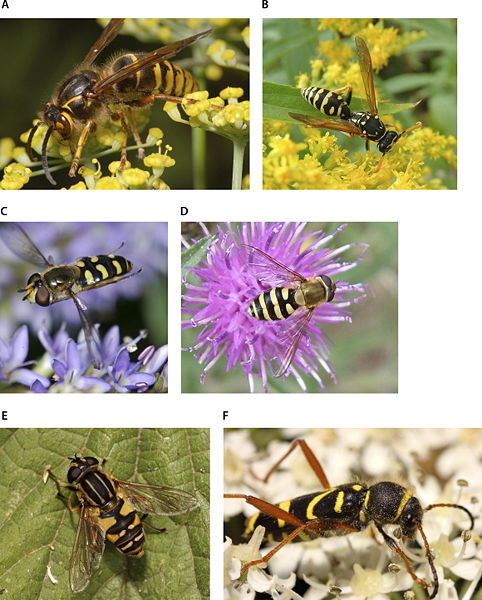
This "convergence" of appearance seems fairly clearly due to information being copied via vision systems of predators and enemies into the genes of insects.
Similarity involving camouflage colouration also plainly involves copying. Many female birds are a mottled dirty brown colour. They are copying colours from environmental backgrounds - in order to blend in. They often look similar because they are copying from similar environments.
So: some convergent evolution plainly involves copying - in the sense described in detail here. However, the thesis here is that all convergent evolution involves copying. Let's look at a few more-challenging cases:
Birds and bats both have wings. They resemble each other - without being closely related. Their last common ancestor had no wings and could not fly. What's being copied here? Here, the copied information involves some aspects of a shared environment, and some things derived from physical laws.
Marsupials and mammals share many common features - and it is widely agreed that many are the result of convergent evolution. However, they evolved on different continents - making copying difficult. What was copied here? Again, shared environments resulted in similar selection pressures - and ultimately similar morphologies. The environments were similar because they were on the same planet - with much the same fauna and flora - due to shared descent.
Even convergent evolution based on the uniformity of nature can be regarded as being likely to involve copying. Why are the laws of physics uniform? The answer involves identity copying. Either the laws of physics were copied from a shared source when now-distant parts of the universe were once closer together - or physical uniformity is due to something like a state machine that iteratively deals with all locations in the universe at each moment in time. The latter case also qualifies as copying - since by definition, copying involves information in one place being later found in multiple places.
The applicability of kin selection theory to cases of convergent evolution is in line with Price's approach to the issue - which is based on correlations between traits. Convergent evolution produces such trait correlations - it is appropriate that kin selection also deals with these.

