Showing posts with label similarity. Show all posts

Wednesday, 9 April 2014

Why the kin vs group selection arguments persist

There have been a few attempts to explain the persistence of the clash between kin selection and group selection enthusiasts, beyond the recognition of the broad equivalence of the approaches.

D. S. Wilson wrote Clash of Paradigms: Why Proponents of Multilevel Selection Theory and Inclusive Fitness Theory Sometimes (But Not Always) Misunderstand Each Other.

Recently Herbert Gintis has offered his perspective in a review of the book Evolutionary Restraints: The Contentious History of Group Selection.

It seems to me that much of the apparent disagreement comes from those on the outskirts of the debate, who don't properly understand it. The last couple of years has seen a number of confused articles - from Steven Pinker, Edward Wilson, Martin Nowak and others - who just don't know what they are talking about.

Part of the disagreement comes from inertia. People get taught one technique and then get attached to it - and are reluctant to use the other 'unnecessary' approach.

I also think this is partly a conservative vs revolutionary issue. Kin selection is the establishment, group selection is the rebel. Kin selection is tried and trusted, group selection is new and disruptive. Theories with these traits appear to different personality types.

There's also the issue of 'selfishness'. Group selection pictures groups that nurture cooperation flourishing at the expense of groups of selfish individuals. Kin selection seems to be promoting a picture of gene level selfishness. This picture is factually false (the reality doesn't change depending on how you look at it) but the connotations are there. Some like to publicly signal their unselfishness via their beliefs. To others, such cheap signalling seems more like tasteless self-promotion.

Lastly there's confusion over cultural evolution. Most of the group selection enthusiasts come from the social sciences. I've repeatedly heard them argue that kin selection only applies to genetic relatives, and that human cooperation extends beyond blood kin - so there must be something else going on. This argument ignores the important topic of cultural kin selection. The "something else" that is going on turns out to be kin selection after all.

Since kin vs group selection seems closely tied to political and moral issues, perhaps we won't see much more agreement on the topic anytime soon.

Saturday, 13 April 2013

Convergent evolution as relatedness

When organisms appear to be similar to one another there are several possible causes: The first category in this list represents kinship - or relatedness. It could be one organism copied from the other, or that both copied from a shared source. This post will argue that convergent evolution can be usefully seen as a type of kinship or relatedness - that the first two categories are fundamentally similar - and that the theory of kin selection applies to both of them.
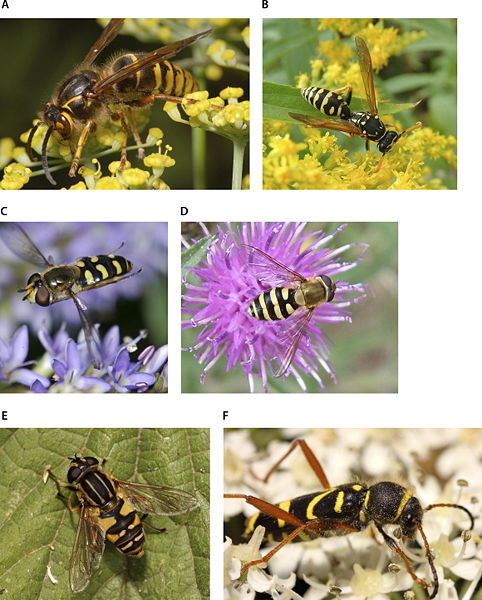
In some cases, it is obvious that similarity between non-kin is due to copying. For example, many unrelated insects resemble wasps. Bees are the best-known example - but many other creatures have adopted the same colouring scheme. This is widely known as "mimicry".

This "convergence" of appearance seems fairly clearly due to information being copied via vision systems of predators and enemies into the genes of insects.

Similarity involving camouflage colouration also plainly involves copying. Many female birds are a mottled dirty brown colour. They are copying colours from environmental backgrounds - in order to blend in. They often look similar because they are copying from similar environments.

So: some convergent evolution plainly involves copying - in the sense described in detail here. However, the thesis here is that all convergent evolution involves copying. Let's look at a few more-challenging cases:

Birds and bats both have wings. They resemble each other - without being closely related. Their last common ancestor had no wings and could not fly. What's being copied here? Here, the copied information involves some aspects of a shared environment, and some things derived from physical laws.

Marsupials and mammals share many common features - and it is widely agreed that many are the result of convergent evolution. However, they evolved on different continents - making copying difficult. What was copied here? Again, shared environments resulted in similar selection pressures - and ultimately similar morphologies. The environments were similar because they were on the same planet - with much the same fauna and flora - due to shared descent.

Even convergent evolution based on the uniformity of nature can be regarded as being likely to involve copying. Why are the laws of physics uniform? The answer involves identity copying. Either the laws of physics were copied from a shared source when now-distant parts of the universe were once closer together - or physical uniformity is due to something like a state machine that iteratively deals with all locations in the universe at each moment in time. The latter case also qualifies as copying - since by definition, copying involves information in one place being later found in multiple places.

The applicability of kin selection theory to cases of convergent evolution is in line with Price's approach to the issue - which is based on correlations between traits. Convergent evolution produces such trait correlations - it is appropriate that kin selection also deals with these.

Wednesday, 28 November 2012

Kin selection's domain

The Price equation pretty clearly implied that any sort of inheritance is likely to be subject to forces associated with kin selection. However, the message seems to have sunk in slowly. Kin selection was applied to DNA-mediated inheritance, but cultural inheritance was almost completely ignored by theorists.

A widespread lack of understanding of the evolutionary significance of cultural transmission could have been responsible. Also, when cultural kin selection was studied, it was often called something else. Tag-based cooperation was one popular term. Tag-based cooperation covers both genetic and cultural kin selection.

Mimicry is another area where kin selection applies. Sysyems involving mimicry may be broadly classified into organic-mimicing-organic, cultural-mimicing-cultural and cultural-mimicing-organic.

Based on the idea of similarity selection, another source of similarity in nature involves convergent evolution. Some convergent evolution involves copying from another organism - for example the parasites of swans may convergently evolve to be white. Other types involves copying from the environment, or from the laws of physics. Kin selection based on convergent evolution may happen - but it isn't easy to think of good examples. Convergent evolution is a research area for kin selection theorists.

Lastly, there's universal Darwinism to consider. Kin selection probably applies to abiotic systems as well - but again, it is not easy to think of good examples. The best cases of high-fidelity copying there are probably crystal growth and positional inheritance. Abiotic systems represent another research area.

Tuesday, 27 November 2012

Kin selection and mimicry

Mimicry is not normally regarded as being a form of kin selection. However, it is pretty clear that mimics engage in copying of traits - and if the individual which is being copied changes its traits, the mimic tracks the changes. Thus, mimicry can be classified as a form of copying (or inheritance) that crosses species boundaries.

There are concrete examples in nature of cooperation based on mimicry. The classic example is the cuckoo. Cuckoos mimic the eggs of their hosts - often in considerable detail - in order to elicit cooperative feeding behaviour from them. The mimicry is necessary - since the hosts employ kin recognition based on egg shell traits in order to identify their own offspring. Modifications in the host eggs are eventually copied by the cuckoo lineage - proving that genuine copying is going on.

Kin selection is clearly involved in the mimicry of the cuckoo - but most would characterize it as a case of kin selection gone wrong - since the benefits go to non-kin.

An alternative analysis looks at relatedness between the copied egg shell traits. These have managed to extend themselves beyond the host species, by copying themselves into another species - thereby gaining access to the resources of a different niche. Since many host eggs perish for each cuckoo egg, this might not seem like a good deal for the trait - but such spreading between species often turns out to be a smart move in the long run.

Of course, mimicry also happens in human culture. For example, viral videos spawn parodies which are a form of cultural mimicry. There's also mimicry between culture and organic organisms - for example, Kermit the frog mimics an organic frog.

Mimicry shows that kin selection can still apply between what seem to be non-relatives, provided they share an inherited trait. Cooperation can result because the traits themselves are kin - in the sense that one of them is copied from the other one.

Saturday, 29 September 2012

Similarity selection

Both Price's formalism and tag-based cooperation strongly suggest that it is trait similarity that is important to evolving cooperation - and that relatedness isn't the sole cause of similar identifying markers leading to cooperation.

This suggests that kin selection's name is dubious - and that the actual effect might be better described as a form of "similarity selection".

Reviewing the causes of similarity in biology, we find:

  • Similarity based on selection
    • Similarity based on mimicry
    • Similarity based on convergent evolution
  • Similarity based on chance
  • Similarity based on inheritance
    • Similarity based on organic inheritance
    • Similarity based on cultural inheritance
    • Similarity based on environmental inheritance
However, looking at where cooperation arises in nature, we see it between relatives, but there's relatively little sign of cooperation based on mimicry, convergent evolution or chance resemblances.

There are some examples of mimicry leading to cooperation. For example, cuckoos generate cooperative behaviour in their hosts by employing egg mimicry. Some orchids mimic the abdomens of their pollinators, to encourage insects to attempt to have sex with their flowers. These examples are instructive: mimicry seems to be associated with producing cooperative behaviour via deception and manipulation.

Chance and convergent evolution seem to result in cooperation much less frequently. The resulting resemblances are rarely close enough.

Convergent evolution may explain the similarity between the wings of bats and birds - however, neither the bats not the birds regard each other as kin, and they don't cooperate with each other especially frequently. Much the same goes for sharks and whales - which are another case of convergent evolution - but not much cooperation arises from the resulting resemblance.

The best example I can think of for similarity which is not caused by some kind of relatedness resulting in cooperation arises in a variant of the prisoner's dilemma. Imagine a group of unrelated agents of various types playing an iterated prisoner's dilemma game with each other - under circumstances where both agents can choose whether to continue with their current partner or pick another one at random from the pool of agents without partners. No agents reproduce, but the worst agents may die. In such a game, the "nice" agents will gradually find "nice" partners, and stick with them - gaining higher payoffs than other agents. They will do this regardless of whether they are related by kinship, or not. These kind of dynamics might help to explain some forms of mutualism. However, there's a problem with describing the cooperation in such models in terms of kin selection. An alternative explanation for the resulting cooperation is reciprocity.

Whether similarity selection really adds anything to the idea of selection based on relatedness is a somewhat contentious point.

The moral of this story is that in practice most, but not all forms of similarity selection take place as a result of relatedness or kinship.

Note that we are not talking about blood relatendess here. Organisms which are memetically related may also come to cooperate - as a result of the related memes manipulating their hosts.

Friday, 14 September 2012

Tag-Based Cooperation

Price's insight about the generality of selection made slow progress into the mainstream. Universal Darwinism is still struggling for acceptance in the mainstream, four decades after Price published. Another important aspect of the generality of selection - cultural kin selection - also laboured in obscurity for a long time. Some memetics enthusiasts understood it, but few others understood them. It wasn't until the year 2000 that the idea began to gather steam in academia - under the term "Tag-Based Cooperation".

A pioneering paper in 2001 - titled "Evolution of cooperation without reciprocity" - introduced the idea. The abstract said:

Here we use computer simulations to show that cooperation can arise when agents donate to others who are sufficiently similar to themselves in some arbitrary characteristic. Such a characteristic, or `tag', can be a marking, display, or other observable trait. Tag-based donation can lead to the emergence of cooperation among agents who have only rudimentary ability to detect environmental signals and, unlike models of direct or indirect reciprocity, no memory of past encounters is required.
"Tag-Based Cooperation" was recognised as a form of cultural kin selection by Sigmund and Nowak in 2001 - as follows:

the mechanism that leads to cooperation is a form of kin selection — either classical (if traits are inherited genetically) or social (if they are inherited culturally, like a dress code).

References