Monday, 18 November 2013

Productive chickens: group selection vs kin selection

Group selection advocates often cite laboratory studies on breeding chickens to maximise egg production.
What they don't mention is that the birds involved were housed by sire family, were close relatives - and the whole process was conceived at the time in terms of kin selection. Check out this quote:

Craig (1982) advocated kin selection, in which pullets are housed in cages together as families with mean performance used as the criterion of selection. He hypothesized that families that perform best tend to have those physiological and behavioral characteristics most appropriate for group well-being and productivity. Muir (1985), Craig and Muir (1993), and Muir (1994) hypothesized that kin selection would favor cooperative tolerant behavior and concluded that selection on family means, when families are kept together as family groups, provides a method of improving traits in which behavioral interactions influence overall well-being and productivity.

The challenge for group selection has always been distinguishing itself from its widely-accepted rival, kin selection. The case of the chickens surely represents a failure to do this.

References

Thursday, 14 November 2013

Tree trunks are not wasteful selfishness

I re-read the Dawkins essay "Gods Utility Function" recently. Dawkins offers an argument against high-level selection in it. However, the article gives a string of dodgy examples. He argues that tree trunks are wasteful:

Why are forest trees so tall? Simply to overtop rival trees. A “sensible” utility function would see to it that they were all short. They would get exactly the same amount of sunlight, with far less expenditure on thick trucks and massive supporting buttresses. But if they were all short, natural selection couldn’t help favoring a variant individual that grew a little taller. The ante having been upped, others would have to follow suit. Nothing can stop the whole game escalating until all trees are ludicrously and wastefully tall. It is ludicrous and wasteful only from the point of view of a rational economic planner thinking in terms of maximizing efficiency. But it all makes sense once you understand the true utility function-genes are maximizing their own survival.
This is wrong. Very tall tree trunks are found in the most efficient dissipating regions of the earth: rain forests. These extract far more energy from incident sunlight that the grasslands that resemble the type of ecosystem which Dawkins is describing as more efficient. Those tree trunks pay off in efficiency terms. If you have a flat surface, it heats up - and the incident energy radiates back into space. You need a lot of surface area to allow water evaporation to keep you cool. The depth produced by tall trees helps to provides such a surface.

In the essay, Dawkins also describes elephant seal sex ratios as "inefficient":

The sex ratio-the proportion of males to females-in wild populations is usually 50:50. This seems to make no economic sense in those many species in which a minority of males has an unfair monopoly of the females: the harem system. In one well-studied population of elephant seals, 4 percent of the males accounted for 88 percent of all the copulations. Never mind that God’s Utility Function in this case seems so unfair for the bachelor majority. What is worse, a cost-cutting, efficiency-minded deity would be bound to spot that the deprived 96 percent are consuming half the population’s food resources (actually more than half, because adult male elephant seals are much bigger than females). The surplus bachelors do nothing except wait for an opportunity to displace one of the lucky 4 percent of harem masters. How can the existence of these unconscionable bachelor herds possibly be justified? Any utility function that paid even a little attention to the economic efficiency of the community would dispense with the bachelors. Instead, there would be just enough males born to fertilize the females.
Unfortunately for this argument, the surplus of males helps the population weed out parasite-ridden and mutation-loaded individuals. A population with fewer males would mean males of lower quality breeding - with the quality of individuals cumulatively declining over the generations. Dawkins' economic argument about how the makes are redundant is simply mistaken. The deaths of the failed males helps the population to adapt by marking out the adjacent gene-space that represent reduced quality - helping the population flee from its parasites and decrease its mutational load.

Perhaps it is possible for trees to be too tall - and for there to be too many elephant seal males. However tall trees and numerous male elephant seals proves very little.

Of course, the basic theme of this essay - that "the true utility function of life, that which is being maximized in the natural world, is DNA survival" is hopelessly mistaken.

Dawkins' argument against multi-level selection in this essay is also incoherent.

Thursday, 31 October 2013

Kin recognition is what kin selection does

One thing I learned from reading "Social Bonding and Nurture Kinship" was that there was a debate over whether kin recognition and other adaptations related to kin selection are really all that different. I had previously absorbed (from the literature on the topic) the idea that "kin recognition" was a subset of "kin discrimination". Looking at another individual and seeing that they are similar to you and other family members is called "kin recognition". Helping nestmates (regardless of whether they resemble you) is called "kin discrimination".

However, another camp holds that kin recognition is what kin selection does. From this perspective dividing "kin recognition" from "kin discrimination" isn't carving nature at the joints. It's trying to make a distinction where there isn't really much of a difference:

I suggest that group or individual recognition systems might well qualify as kin recognition regardless of the cues used, provided that the groups or individuals so recognised are routinely kin and that the fitness benefits associated with recognition typically flow among kin. Grafen's insistence that kin recognition be a function of genetically based cues and that no individual or group recognition system should qualify excludes many recognition systems that may well function to associate kin in a fitness enhancing context. Kin recognition is an inherently functional concept and any definition or restriction that relies too much on a particular mechanisms or source of cues is problematic. (Stuart 1991).

I've warmed up to this. "Kin recognition" and "kin discrimination" is too much terminology for what is basically one type of effect. "Kin recognition" is the more popular term (by a factor of five). The "kin discrimination" category is surely the more useful one. I think we should just refer to "kin discrimination" as "kin recognition".

Sunday, 29 September 2013

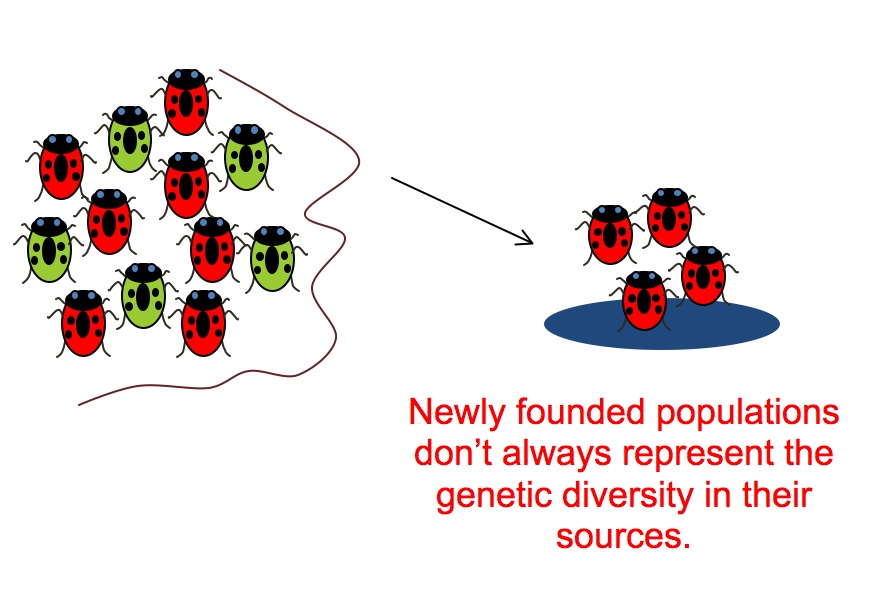
Kin selection, population bottlenecks, founder effect

Kin selection theory raises the possibility that organisms may use variation between them as clues to relatedness - and direct cooperative behaviour preferentially towards perceived relatives. This effect is sometimes referred to as "kin recognition".

However, this method of identifying relatives depends on the existence of population-scale variation. Population bottlenecks can destroy such variation - and may promote cooperation.

Similarly, the founder effect might also produce local regions with little variation.

These effects have been demonstrated experimentally:

In theory, kin selection should mostly produce adaptations that work on relatedness cues that dynamically take overall population similarity into account. However, kin selection effects must work by manipulating development. Cruder measures of detecting similarity and relatedness will often be employed in practice.

Humans are among those species that have experienced a relatively recent population bottleneck - in the form of the Toba catastrophe. It is intriguing to consider the scale of the resulting increased levels of cooperation between humans that might be the result of this.

Saturday, 28 September 2013

The problem with cultural group seletion

What do you get when you put two new theories together?

In the case of cultural evolution and group selection, what you seem to get is a big scientific muddle. Let me explain:

Many modern cultural theorists treat culture as a second inheritance channel that affects and modifies human phenotypes (extended phenotypes in the case of artifacts). This is instead of modeling cultural symbionts as separate lineages with distinct phenotypes of their own. For more on this see Against the extended genotype

This perspective has led to multiple claims that group selection is responsible for various features of human culture:

For example monogomous marriage customs and human ultrasociality have both been recently attributed to group selection.

There are two separate problems with this sort of literature:

The first is that typically no evidence is presented to show that these memes are deleterious within groups. If you count the spread of memes that are simply advantageous as a form of "group selection", then all widespread cultural phenomena qualify and the term becomes meaningless. Group selection theorists should try harder to distinguish between group selection and byproduct mutualism - which can both produce "groupish behaviour", but by independent mechanisms. It is true that some individuals benefit from polygamous marriage and anti-social selfishness, but other individuals are harmed, and if the balance is positive, group selection must compete with an obvious explanation: that some individuals are manipulating other ones using memes which have high average fitness and spread by perfectly ordinary natural selection.

The second problem is that - just because you can model a phenomena using multi-level selection and the Price equation, it doesn't mean that it makes sense to do so. Rather than observing that selection on human hosts and selection on memes operates on different scales - and reaching for the multi-level selection toolkit - what should happen is that the fact that humans and their memes are not geneaologically related should be noted, and they should be modeled as independent species using natural selection on humans and natural selection on memes. Multi-level selection is an unnecessary and confusing complication in such cases.

To illustrate, compare with the case of the smallpox virus. Smallpox germs wiped out many native Americans. The smallpox scabs are an aspect of individual human phenotypes. They are deleterious to individual humans (they kill people). However has historically been advantageous to human *groups* to have the smallpox phenotype - since this trait obliterated many competing tribes of humans (e.g. see American history). I think that few would advocate multi-level selection modeling in this case. There are two distinct types of entity involved here: humans and the smallpox virus. Natural selection operates on them more-or-less independently. Group selection brings no enlightenment and much confusion to this situation. The idea that smallpox scabs are traits which spread because they are deleterious to individuals and advantageous to groups is just a misleading and bad way of looking at the situation. It could equally well have been true that smallpox scabs were deleterious to human individuals and human groups - in which case it could still spread for its own "selfish" reasons. Group selection would then have been a red herring in explaining the spread of smallpox.

What holds for smallpox virus scabs holds for many kinds of memes. "Gun" memes result in people dying just as surely as in the case of the smallpox virus. Like smallpox, guns killed many native Americans - and gun memes provide broadly-similar group level advantages. You can model the spread of gun memes using multi-level selection and the Price equation. It is an unenlightening and confusing thing to do, but you can do it.

Its much the same with monogamy memes and cooperative memes. Memes don't interbreed with humans - they are more like separate species. So, you can forget about multi-level selection and just apply ordinary natural selection models to the humans and the memes - and have a much cleaner, neater model. Since human genes and memes are more like different species, it is an unnecessary source of complication and confusion to muddle them together in a unified multi-level selection model - just because they influence the same phenotypic traits sometimes.

It's worth sorting this muddle out - partly because memes exhibit their own kin/group selection dynamics, which can be important and significant. This is where genuine kin sleection/group selection operate in the cultural realm. If "cultural group selection" gets turned into a meaningless catch-all term for cultural phenomena which spread despite being deleterious to human hosts, it risks losing the possibility of performing useful work in other contexts.

References

Saturday, 13 April 2013

Convergent evolution as relatedness

When organisms appear to be similar to one another there are several possible causes: The first category in this list represents kinship - or relatedness. It could be one organism copied from the other, or that both copied from a shared source. This post will argue that convergent evolution can be usefully seen as a type of kinship or relatedness - that the first two categories are fundamentally similar - and that the theory of kin selection applies to both of them.
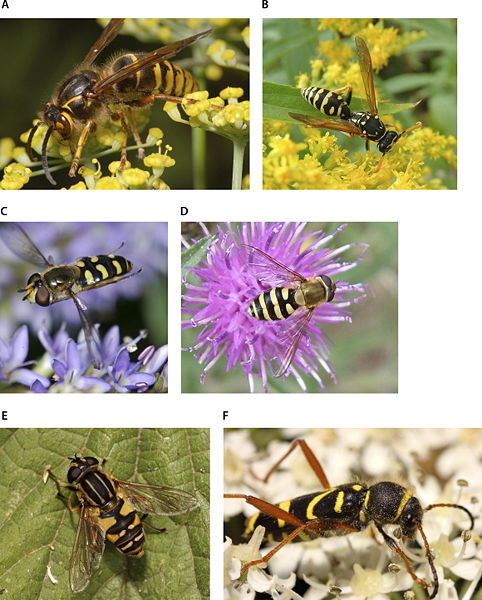
In some cases, it is obvious that similarity between non-kin is due to copying. For example, many unrelated insects resemble wasps. Bees are the best-known example - but many other creatures have adopted the same colouring scheme. This is widely known as "mimicry".

This "convergence" of appearance seems fairly clearly due to information being copied via vision systems of predators and enemies into the genes of insects.

Similarity involving camouflage colouration also plainly involves copying. Many female birds are a mottled dirty brown colour. They are copying colours from environmental backgrounds - in order to blend in. They often look similar because they are copying from similar environments.

So: some convergent evolution plainly involves copying - in the sense described in detail here. However, the thesis here is that all convergent evolution involves copying. Let's look at a few more-challenging cases:

Birds and bats both have wings. They resemble each other - without being closely related. Their last common ancestor had no wings and could not fly. What's being copied here? Here, the copied information involves some aspects of a shared environment, and some things derived from physical laws.

Marsupials and mammals share many common features - and it is widely agreed that many are the result of convergent evolution. However, they evolved on different continents - making copying difficult. What was copied here? Again, shared environments resulted in similar selection pressures - and ultimately similar morphologies. The environments were similar because they were on the same planet - with much the same fauna and flora - due to shared descent.

Even convergent evolution based on the uniformity of nature can be regarded as being likely to involve copying. Why are the laws of physics uniform? The answer involves identity copying. Either the laws of physics were copied from a shared source when now-distant parts of the universe were once closer together - or physical uniformity is due to something like a state machine that iteratively deals with all locations in the universe at each moment in time. The latter case also qualifies as copying - since by definition, copying involves information in one place being later found in multiple places.

The applicability of kin selection theory to cases of convergent evolution is in line with Price's approach to the issue - which is based on correlations between traits. Convergent evolution produces such trait correlations - it is appropriate that kin selection also deals with these.

Sunday, 7 April 2013

Clade selection

"Kin selection" and "group selection" are common terms for the way that organisms help organisms which are similar to themselves. I've proposed the term "similarity selection". Another contender is "clade selection". This term came from George C. Williams (1992).

Dawkins said of this:

Williams efficiently disposed of “group selection,” which never recovered (except as a muddled version of kin selection). But in Natural Selection: Domains, Levels and Changes (1992), where he gathered many threads of thought, he developed the important and superficially similar idea (foreshadowed in Adaptation and Natural Selection) of “clade selection” to explain, not “altruism” but macroevolutionary patterns of diversity and - as I would put it - “the evolution of evolvability.”

"Clade selection" seems like better terminology than "group selection" - in some respects. Like the term "kin selection" it puts an explicit emphasis on relatedness. Group selection only works - in the sense of producing group-level adaptations - when relatedness is involved. So: why not use the term clade selection?

Alas, I think there's a good reason not to use the term "clade selection". A clade consists of an organism and all its descendants. The problem is with the "all". You can still have group selection that works without it being clade selection - by the fitness delta involved not affecting all the descendants.

The "all" in "clade" makes "clade selection" a confusing term. Not worthless, perhaps, but I don't think I can endorse the term.